 Making $1.000.000.000 in Forex aint easy but many traders do it!
The goal of any forex trader is to maximize profits. But it ain’t easy unless you have a solid strategy. In fact, 95 per cent of traders have no clear plan on growing their equity.
They often fail to apply the fundamental analysis, and end up making losses or smaller profits than anticipated.
A quote by John D. Rockefeller is apt in this regard:
‘The secret of success is to do the common thing uncommonly well’.
If you’ve been unsuccessful in getting your trading right, and struggled to make consistent profits, the good news is that trading can be learned and improved over time. Don’t let the lack of results and frustration resulting from the same pin you down. There’s never a better time than now to reexamine your trading approach with a fresh pair of eyes. By incorporating a good trading plan you can become a more enlightened and a better trader.
You need a well thought-out trading plan that tells you how to spot and capitalize on market opportunities quickly. This plan should be based on trading fundamentals and empirical evidence.
The trading strategy is rather a concept than a blueprint to entering and exiting the market.It consist of a trading plan and a trading approach to markets.
Many traders when they talk about trading strategy they talk about conditions under which the market is entered. In fact the trading strategy must also include you overall approach to markets,price and risk.
Some traders would trade only certain market at only certain times. Others would go in and out many time a week when other would be locked in the trend for days and weeks adding to their positions. Some traders would trade market reversal when others would follow the trend.
For starters you need to establish some grounds for your trading strategy. There are few fundamental keys that will help you to establish that and gain better returns in the long run.
1. Establish Trading Journal
Trading Journal is a crucial tool for every serious Forex Trader.
It’s natural for forex traders to shirk from maintaining a trading journal, purely because all brokers provide real time records of trades, apart from other data (like margin usage, profits and losses per trade, and buying power) that a trading journal doesn’t capture.
However, you’ll seldom find a successful forex trader who doesn’t leverage a good old trading journal for intelligent trading moves.
For starters, a trading journal gives a historical perspective to your trading activity, helping you summarize the trade. Important information such as the currency pairs that work best for you, the frequency with which you traded in a past period, per trade success, and time frames that yielded best profit percentages, can be accessed anytime from a trading journal. This makes the trading journal a personal database from which you can learn and discern intelligible patterns, which can help you progress your trading skills, and avoid making same mistakes again.
A trade journal also lets you record your personal goals and expectations from every trade in the form of notes and comments. This helps you control and plan escort each trade exceptionally well, and in a result-centric manner. Plus, over a period of time, your trade journal will capture enough data to help you work out and verify your methodologies of trading. All these benefits significantly improve your chances of faring well with forex trading.
Trading Journal might not be time consuming or hard work at all. Even simple excel spreadsheet or WordPress blog can prove to be very efficient to track and record your trading.
I keep a simple google doc to document my progress (HERE ) and
I publish all my trades online to keep the record of the logic behind each trade I took ( HERE )
2. Stress-Test your strategy
Simply put, your trading plan is your Bible, the rule book governing your trading decisions. Specify your entry and exit criteria and your money management istanbul escort goals in your trading plan, and stick to it religiously, of course, the assumption is that your trading plan is made after thorough deliberation and testing.
Technologies like simulation tools help you put your trading plan to the test without risking any real money. By ‘back-testing’ you can apply your trading rules and strategies to historical data and evaluate the returns. If the results are good, you can implement the same in real world scenarios. Also, simulation tools help you stress test your trading plan, by emulating market conditions similar to financial crises. These tests yield massive insight into the flaws and strong points of your trading plans.
Remember, as a serious forex trader interested in long term gains, working without trading plans is like rowing upstream without your oars. In fact, every successful trader has a well-guarded and customized trading plan, a rule book that they keep on fine tuning as they gain Madult.net more market insight and verify the credibility of their trading methodologies.
Your trading plan must change over time together with changing markets.
The important thing is to remember that markets are constantly changing. Your plan must adopt to new conditions and improve over time. Testing your strategies is crucial for your plan to work. Make sure you test all hypothesis and have hard, statistically significant evidence of every test you perform.
Below are few elements that every trader should consider when building a sustainable trading strategy
Long-term bias and Understand Macro Economics
A quick look at any financial news daily is not enough to succeed in this game. Smart Money Traders know how to differentiate fads from trends, and that’s possible with working knowledge of concepts of macroeconomics and their practical significance.
Master traders always analyze market developments in terms of their impact on parameters like GDP. Plus, they are always able to make more sense of important macroeconomic policy changes such as interest rate revisions. So, invest some time in grasping the essences of all macroeconomics concepts, right from interest rates and inflation to GDP, earning or manufacturing, to equip yourself with the foresight that’s vital for successful forex trading with a long term perspective.
Your course should start with inflation, GDP, Interest Rates, Earnings.
Ensure that, not only you understand these concepts, but also you know how that data is reported to the markets on weekly basis and does it impact every currency.
Risk Events Calendar
Every serious Traders must follow weekly Risk Event Calendar
Risk calendars are vital tools in the hands of forex investors that can help prepare them for the upcoming buzz in the market, so that they can analyze and suss up the situation, and plan their moves to land up on the right side of the movements in the market. There’s no alternative to dedicate tracking risk calendars, identifying the critical upcoming events that could move the markets, and then deciding on a strategy in accordance with your trading plan to buy or sell at the right times.
For cutting edge insight, forex traders can follow all meetings of the Central Banks, and can make informed estimates of the decisions likely to be made, and their impacts on the market. The official website of the central bank is a ready source for meeting minutes.
Financial news websites also publish copies of these minutes after they are publicly released by the banks. Smart investors can pick up hints and cues, and can detect the pulse of the economy from the minutes, and can foretell events such as interest rate revisions, inflation control measures, etc. It’s a must for every serious trader
Support and resistance

Once you position yourself on the right side of the market, you must learn to spot support and resistance. These levels comprise of a large number of orders and trades are entered near them.
Resistance is defined as an area where the price stalled or reversed in the past.
Support is defined as the area where the price stalled or revered in the past.

It’s important to think about S&R as an area rather than just an exact price. Market might move10-50 pip range and the whole range will be Support or Resistance.
The golden rule with regards to S&R are:
Never sell support: This is the price where the price can be considered a ‘bargain’. Upon hitting this price level, buyers are encouraged to purchase more, and demand (buying pressure) exceeds supply (selling pressure). As a result, the price increases.
Never buy resistance: At this level, the currency is believed to be expensive, and its price is expected to fall. This is where sellers move in, the selling pressure/supply exceeds the demand/buying pressure, and the price falls.
You should ideally buy at or close to support. In reality, many traders tend to give in to emotions and buy close to resistance with the hope/assumption that price will continue its upward journey.
What happens then, the price pulls back and long positions entered at the resistance get stopped out.
Similarly, you should sell at or close to resistance, which is the opposite of what traders do, thereby committing a common forex trading blunder.
Trading using support and resistance is a good way to enter the market at the low risk.
Short-term patterns
The markets are influenced by a range of factors and you may find the price action changing every day.
For instance, a long-term bull market can be bearish over the short term.
It is very important to understand these fluctuations to be able to keep your bias.

For an experienced trader with clear bias, pull back is an excellent opportunity to add to their existing positions.
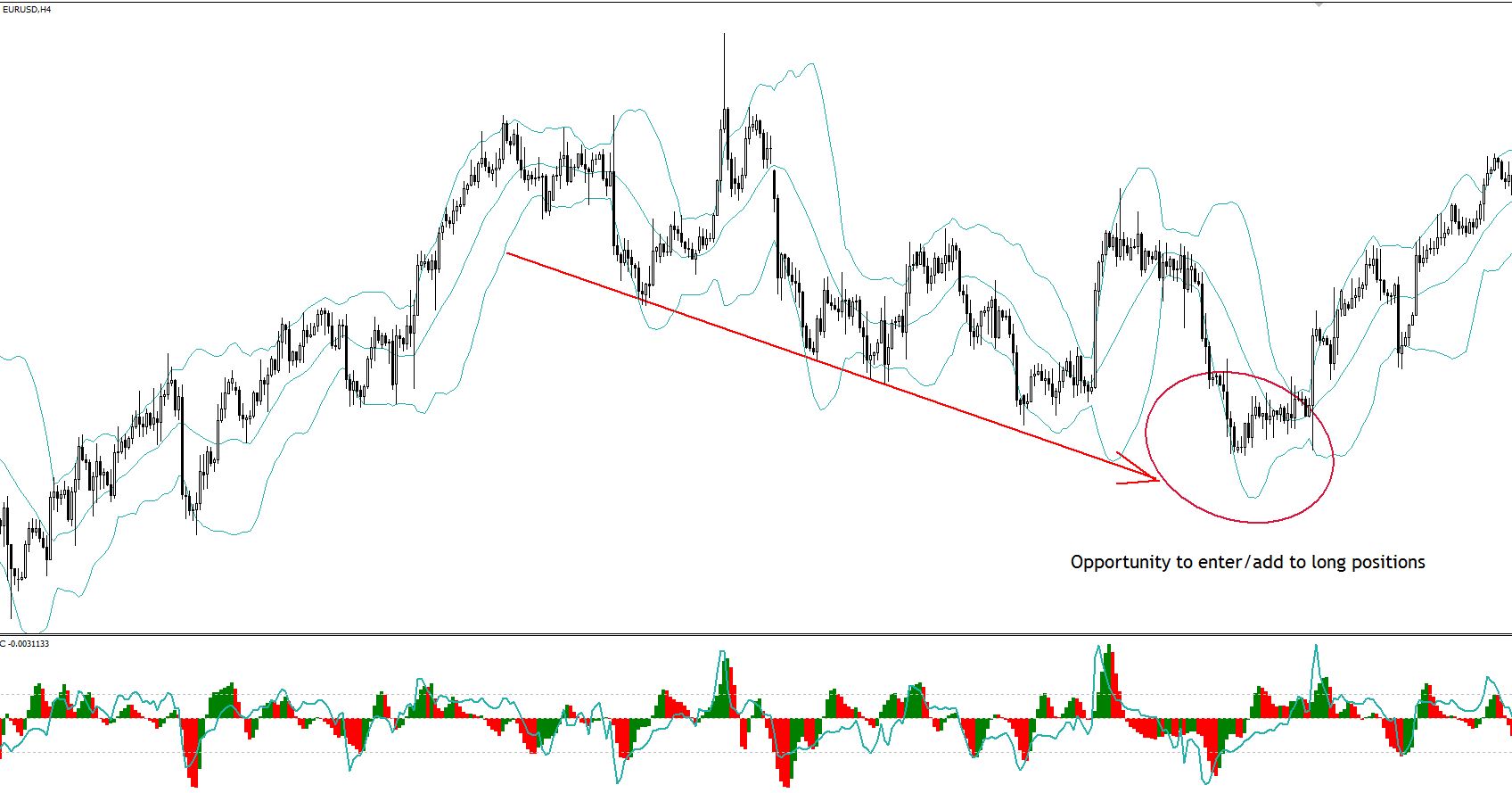
For a novice trader with no clear bias, pull back is scary. He will watch the price rallying and his profits diminishing. He will eventually close his position with a small profit. The price will then resume its long term downtrend.
Every trend is a series of new highs/lows with pull back between.
That means only entering positions after confirming the reversal pattern and all required retracements are in place.
The golden rule to remember in this case is:
- Selling only in a falling market
- Buying only in a rising market

Advanced risk management
Limit your losses and exceed your gains
Forex traders find themselves in a push-pull over reducing the size of a potential loss but also wanting to get as much as possible out of a single trade.
To get the highest returns, you will need to take big risks.
Whoever take big risks fails eventually.
Trader must be prepared to take 10 consecutive losses at some point in his career.
Below is the chart of two approaches:
Risking 2% and risking 10% per trade. You clearly see that risking 2% per trade is much healthier/saver approach in the long run.

Successful traders grow their equity through compounding.
Have a few advanced risk management strategies up your sleeve to cut your losses and improve your gains.
- Target gaining twice as much as to lose every time.
- Hedge positions with short-term binary options. For instance, you can use one entry point to open two positions, a buy and a sell. Cash position have unlimited upside; the option expires in time.
- Be long cash and short option. Avoid risking more than 2 per cent of your equity.
- Cut your losses without hesitation; let your winners run.
Even if you are 40 per cent accurate and lose half of what you win, you will still make hell lots of money!
As you now know, all the above is not anything new.
This is a very simple approach which, once implemented properly will lead you to success in this game.
At the same time, it is also important not to fall into common forex trading traps.
You are probably wondering: Is that it? Well… It is!
The problem is, many traders don’t understand it and they commit their time and money to find this so called “Holy Grail”. They don’t exist. They move from one technique to another but they never master basic principles.
Hard work, understanding, learning and persistence are the keys to be successful in this game.
They all take time.
